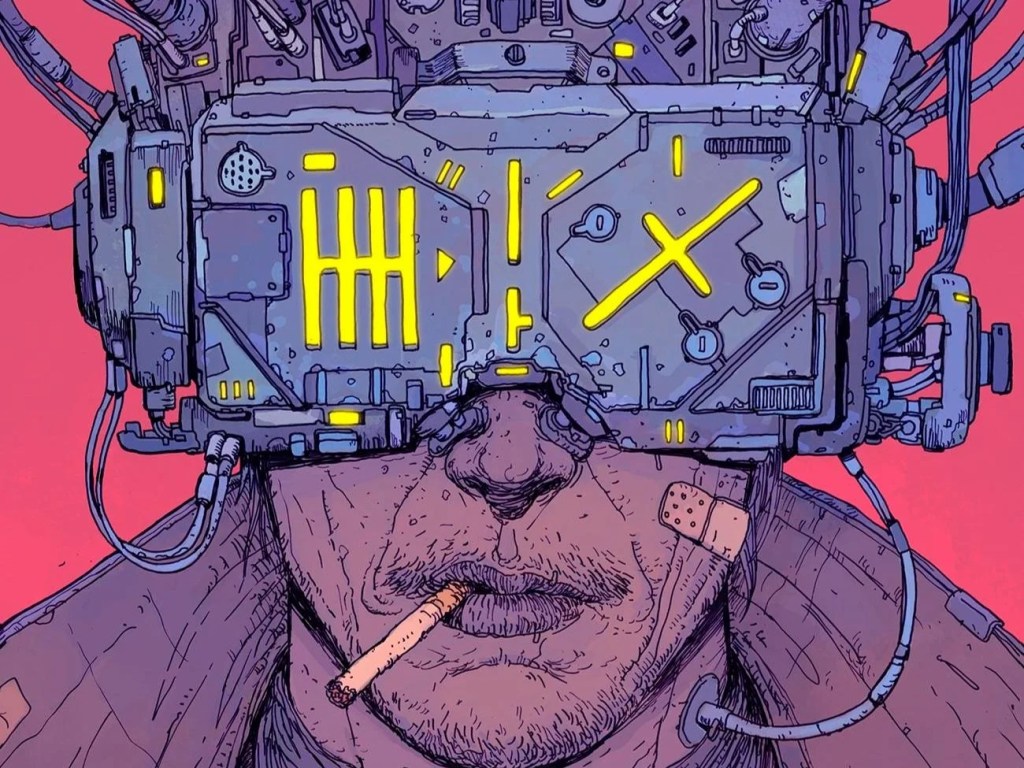
“The two worlds obey different imperatives, different directives, and different laws which have nothing in common. Just as hydroelectric installations take waterfalls and lead them into conduits, so the technical milieu absorbs the natural.”
The Technological Society (1954)
Jacque Ellul
The 1970s can be understood as a typology of the current economic, social, and cultural troubles of America, the Anglosphere, and Western Europe at large. It was at this time failures of fiscal policy, industrial decline, and culture conflict became permanent features of an aging post-war consensus. Out of this malaise emerged a unique literary subgenre, Cyberpunk.
The so-called cyberpunk writers sought an intertextuality unforeseen in the literary ghetto of science fiction. Blending elements of noir detective fiction, dystopian speculation, and absorbing, either consciously or subconsciously Baudrillardian concepts of hyperreality, and the death of the real, the Cyberpunk literary movement reflected and exaggerated postmodern tendencies in its treatment of technology, identity, society, and reality.
This new literary movement decentered the human subject, in his place: the machine, technique, ruthless, unceasing efficiency. On a cursory reading, a latent techno-skepticism emerges from the text. A common theme, one that presents technology as a mechanism of hegemonic control. Not by the state, but capital. The Cyberpunk protagonist navigates a fragmented hyperreality, where state and capital, human and machine are perpetually blurred, illustrating a world in which control is an illusion, and identity is a fluid, ever-shifting construct of the mind’s eye.
As a postmodern literary form, cyberpunk reflects the dissolution of stable narratives and the collapse of traditional structures, embracing a fragmented and disjointed approach to storytelling. In this context, it echoes Heidegger’s conception of territoriality, where the notion of ‘space’ is not simply a physical container, but an existential condition of being. Heidegger argued that our relationship to space—what he called ‘dwelling’—is fundamental to our sense of being-in-the-world. In cyberpunk, this ‘dwelling’ is always in flux, constantly shifting between virtual and real, human and machine. The characters inhabit a fragmented world, constantly negotiating their place within a system of control that is at once expansive and confining. As Heidegger suggests, ‘Space is not a thing, it is the condition for the things that appear in it.’ In cyberpunk, the digital, corporate, and physical spaces are no longer neutral—they are saturated with meaning, power, and potential for both liberation and oppression, marking a complex interplay of territoriality where the boundaries of the self and the world are constantly redrawn.
The authors of the 20th century couldn’t fathom the social implications of our rapidly accelerating technological environment. In the works of William Gibson, we are a presented a future where humans can interface seamlessly with cyberspace, enabling the exploration of infinite realms of the unreal, but people still meet in person for social engagements at bars, restaurants, and other third places. Vast neural networks – artificial intelligences are able to preserve simulacra of the dead, but the complexities of globalization, the international supply chain have not materialized.
Today’s digital landscape is less about exploration and more about surveillance, monetization, and the commodification of our every online interaction. The flesh space of Gibson’s world has shifted into hybrid environments that blend physical presence with constant virtual connectivity. The social fabric: rather than becoming decentralized in the way Gibson predicted, has been largely restructured by tech giants, reshaping both interpersonal relationships and expectations of what it means to be present.
Yet, in hindsight the cyberpunk narrative reveals a more complex paradox. The machines that were once symbols of oppression and alienation have become extensions of the self, entangled in the very fabric of our identities. What was once imagined as the dehumanization of society through technology has, in practice, led to an amplification of human experience. The postmodern anxieties around autonomy and control have been replaced by a new, uneasy complicity—where technology is no longer an external force, but a mirror of our desires, flaws, and obsessions. The cyberpunk dream of rebellion has shifted; the struggle is no longer against the machine, but within it, as we navigate a world where our very essence is now coded, monetized, and algorithmically managed.
In our new world, the lines between organic and artificial, real and unreal have been permanently blurred. We are co-authors of our own digital mythology, weaving ourselves into the very systems that threaten to erase us. Are we the architects of our own destiny, or merely the data we leave behind? As the lines between the digital and the physical dissolve, perhaps the true rebellion is not against the machine, but in reclaiming the agency to shape the world and ourselves within it.
 colemorganwrites